Airedale helps you research ideas critically, quickly.
Start with a rough idea, pressure-test it with agentic research, expose weak assumptions, and leave with an automatically organized thesis, MECE issue tree (mutually exclusive, collectively exhaustive), facts, sources, and claims behind the direction you choose.
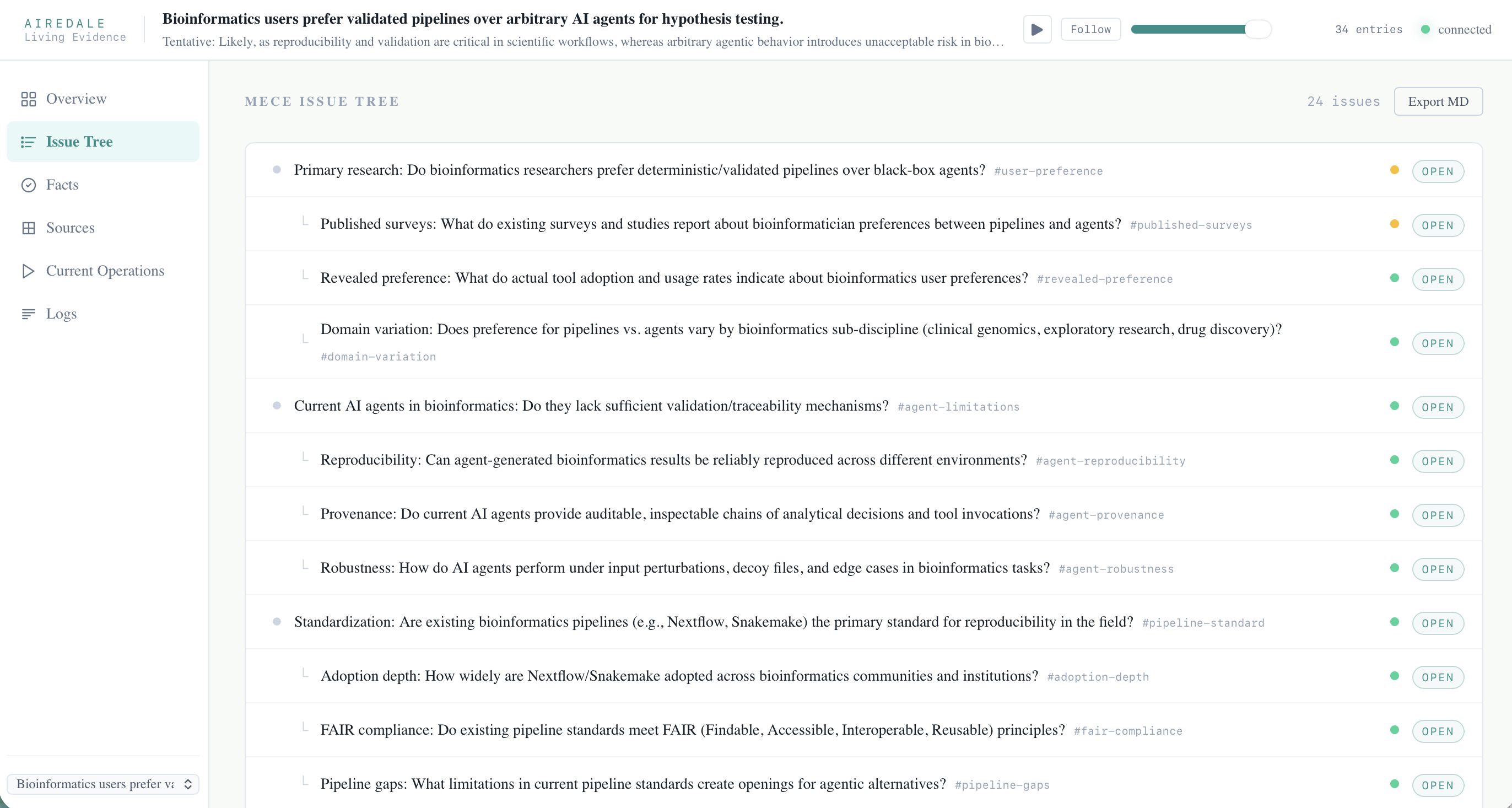
Move from promising idea to sharper answer faster.
Airedale is for the stage where a plausible idea needs fast research, criticism, and enough context for someone else to review the thesis, MECE issue tree, supporting facts, sources, and claims.
Find the weak points sooner
Push an idea through structured research steps so assumptions, missing context, and fragile claims surface while they are still cheap to fix.
Move faster without losing the thread
Run idea research inside the agent tools you already use while keeping the steps, tool calls, and intermediate context connected.
Leave with a reviewable research record
Airedale automatically organizes the thesis, a MECE issue tree, facts, sources, and claims behind the idea, so reviewers can see what changed and why it matters.
Use the agent subscription you already have
Airedale works with Claude, Codex, or OpenCode, so teams can bring critical idea research into their existing agent setup.
./airedale launch {claude|codex|opencode} --cd /path/to/folderWhat Airedale organizes automatically
Instead of leaving you with a loose transcript, Airedale structures the research around the artifacts people need to make a decision.
Thesis
Keep the current best answer explicit, so the team can see what the idea is becoming.
MECE issue tree
Break the uncertainty into mutually exclusive, collectively exhaustive questions that cover the decision without overlap.
Facts, sources, and claims
Separate what is known, where it came from, and which claims still need support.
Know why the idea changed
Useful idea research is not just a better final paragraph.
Airedale helps you see the path from first thought to current thesis: which issues mattered, which facts moved the answer, which sources were used, and which claims still need support.
Frequently Asked Questions
What is Airedale?
Airedale is an idea-research tool that helps pressure-test a rough idea and automatically organizes the research record behind it.
What does it organize?
It organizes the thesis, a MECE issue tree, facts, sources, and claims so the reasoning is easier to review.
Who is it for?
Airedale is for founders, product teams, researchers, and analysts who need to turn a promising idea into a clearer, more defensible direction quickly.
Does the user need to manually maintain the record?
No. Airedale automatically records and organizes the research artifacts as the idea evolves.
Want to use Airedale for critical idea research?