The Control Plane for AI Agents
20minds provides access to the best open source agents
With consistent authentication, policies, observability and billing built in
Integrate Once.
Switch agents anytime.
Upgrade without refactoring.
Meet Your 11 Co-Scientists:
From ideas to discoveries, faster.
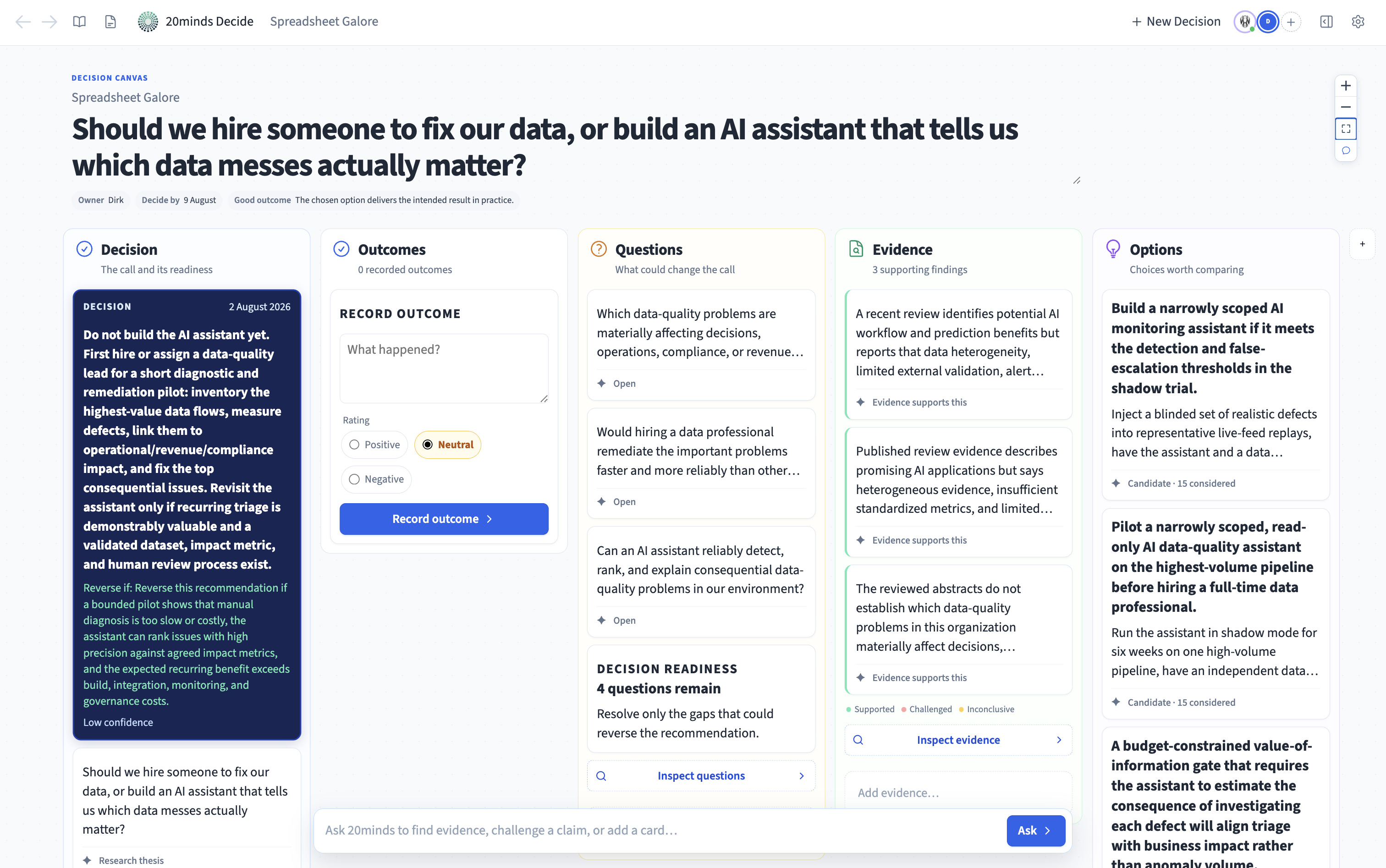
20minds Co-Scientist
Our Co-Scientist acts as a collaborative partner designed to work side by side with computational scientists in healthcare, engineering, or product. It offers fast, interpretable, and actionable insights from your and public data. It is named after the Border Collie which is known to herd with intelligence, agility, and responsiveness.
Clinical risk prediction assistant backed by large calculator toolkits.
AgentMD is a clinical decision-support agent that finds and runs medical risk calculators (for example, triage and prognosis scores) from the research literature. It was built from a curated library of more than 2,000 executable clinical calculators and can automatically choose the right one for a patient case, delivering more accurate risk predictions than a general chatbot baseline. It can also aggregate results across many records to support hospital-level quality and risk management analysis.
Jin et al. (2025). AgentMD: Empowering language agents for risk prediction with large-scale clinical tool learning. Nature Communications, 16, 9377.
Biomni is a general-purpose biomedical AI agent that autonomously executes complex research workflows across diverse biomedical domains.
Biomni is a general-purpose AI research assistant for biomedicine. It can help scientists plan and run complex research workflows across many areas of biology and medicine by combining literature/tool retrieval, reasoning, and code execution. Instead of relying on fixed templates, Biomni can assemble multi-step analyses dynamically, making it useful for tasks such as gene prioritization, drug repurposing, rare disease investigation, microbiome analysis, and protocol generation from real-world biomedical data.
Huang et al. (2025). Biomni: A General-Purpose Biomedical AI Agent. bioRxiv preprint.
Hierarchical deep-research agent orchestrating specialist sub-agents across biomedical sources.
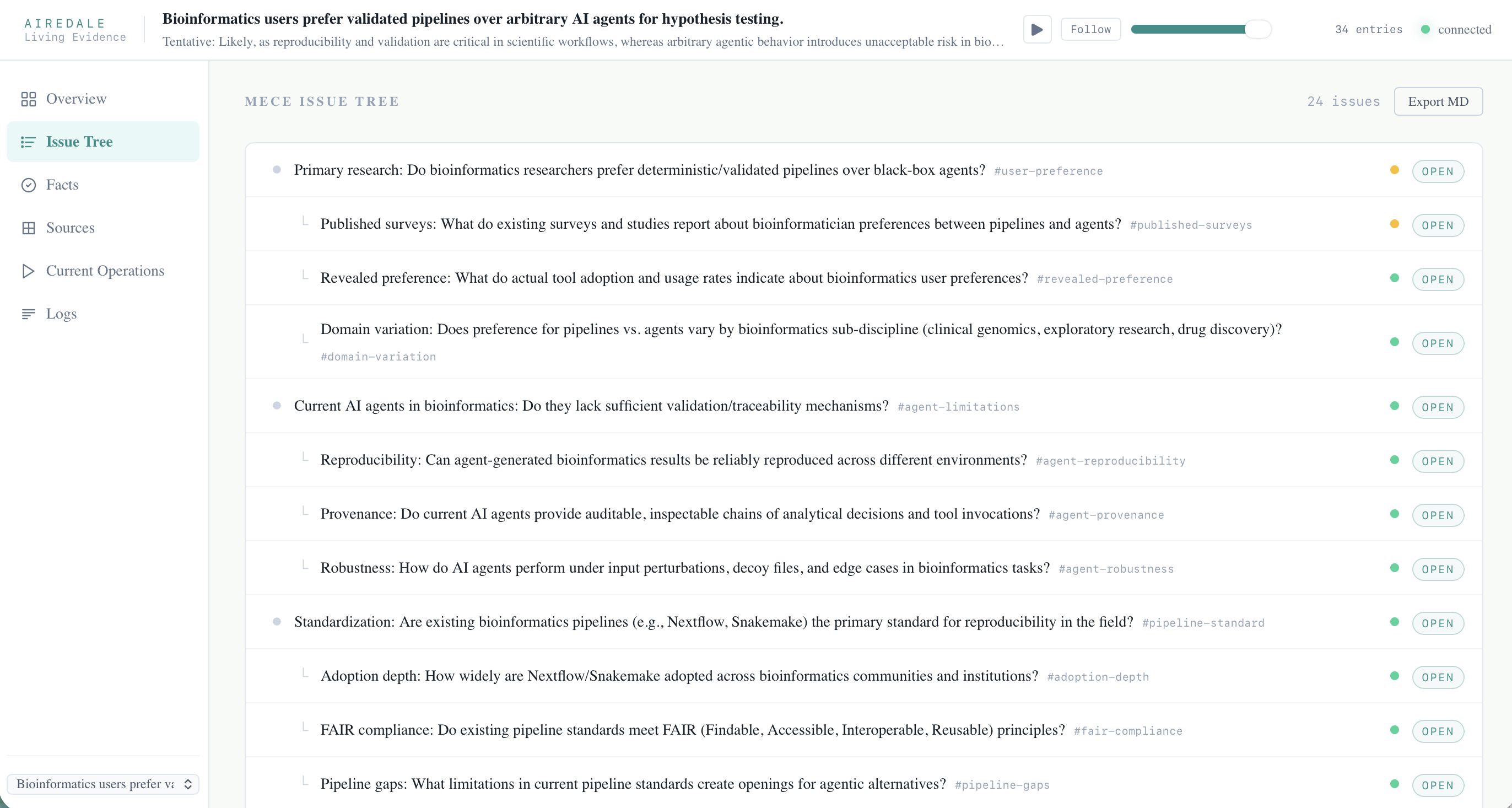
DeepEvidence is a biomedical research agent built to explore many specialized knowledge sources together, especially biomedical knowledge graphs that connect genes, diseases, drugs, pathways, and clinical evidence. It combines broad search across multiple resources with deeper multi-step reasoning to gather, organize, and synthesize evidence into a structured view. This helps researchers investigate complex questions more systematically across the full discovery pipeline, from early drug discovery to clinical research and evidence-based medicine.
Wang et al. (2025). DeepEvidence: Empowering Biomedical Discovery with Deep Knowledge Graph Research. arXiv preprint.
Data-science runtime optimized for iterative coding and streamed analysis in the co-scientist loop.
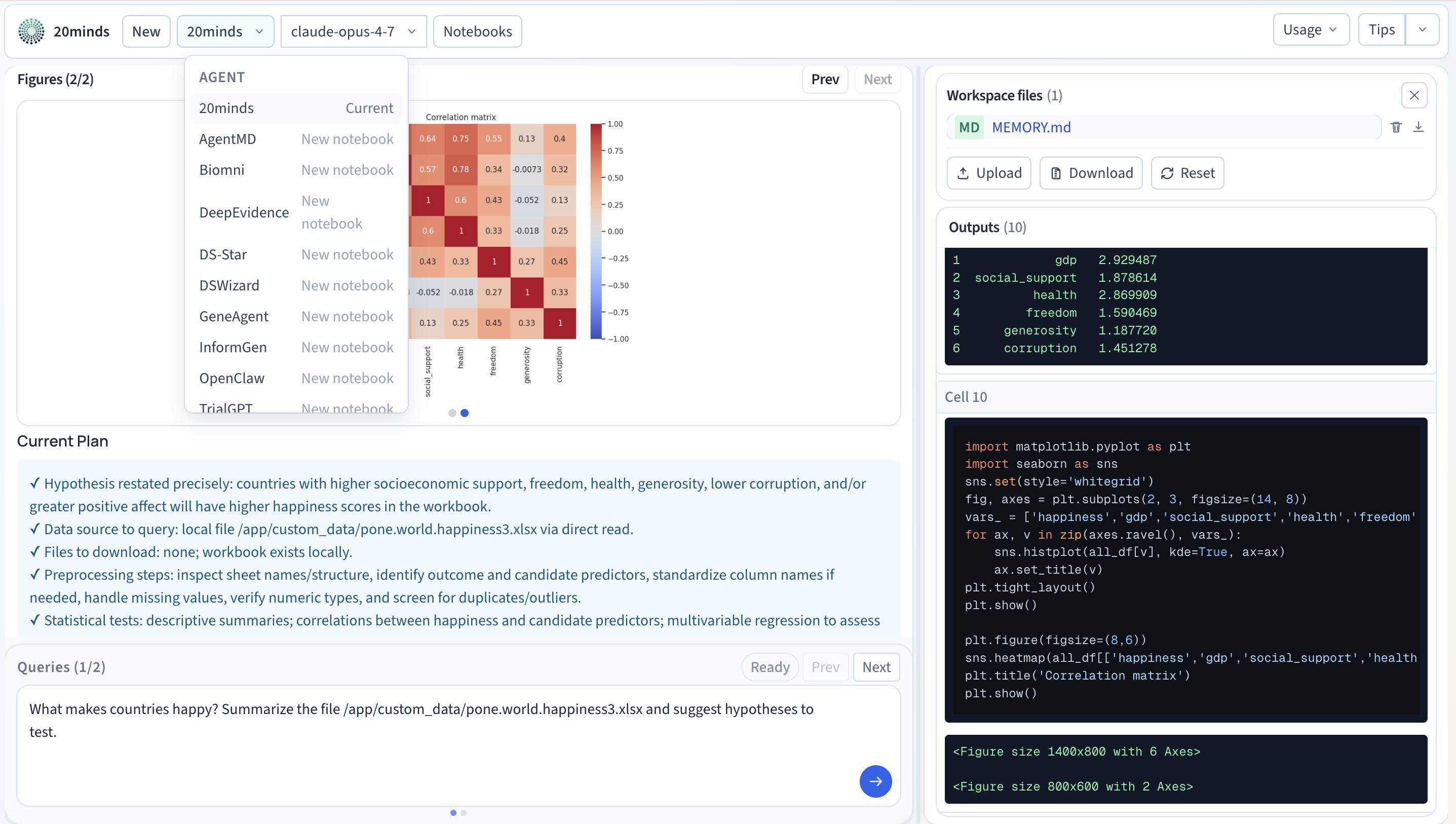
DS-Star is a data-science agent designed for real-world analysis tasks that involve messy, multi-file datasets and open-ended questions. It can work across different file formats, combine information from multiple sources, and produce full research-style reports instead of only short answers. In evaluations, DS-Star performs especially well on harder tasks that require multi-file reasoning and code-based analysis.
Nam et al. (2025). DS-STAR: Data Science Agent for Solving Diverse Tasks across Heterogeneous Formats and Open-Ended Queries. arXiv preprint.
Two-phase biomedical data science agent (planning then implementation).
DSWizard is a biomedical data-science agent designed to improve reliability by planning before coding. Instead of jumping straight to code generation, it first drafts and refines an analysis plan with the user, then implements the plan in code. This workflow helps reduce errors in AI-generated analyses and visualizations and supports researchers in collaboratively building accurate analysis pipelines.
Wang et al. (2026). Making large language models reliable data science programming copilots for biomedical research. Nature Biomedical Engineering.
Gene set analysis agent with self-verification against structured biological databases.
GeneAgent helps researchers interpret gene sets by generating biological explanations and then checking its own conclusions against trusted biological databases. This self-verification step is designed to reduce hallucinations and improve factual accuracy compared with a general-purpose chatbot. It is useful for turning lists of genes into clearer, more reliable hypotheses about underlying pathways, functions, and disease mechanisms.
Wang et al. (2025). GeneAgent: self-verification language agent for gene-set analysis using domain databases. Nature Methods, 22, 1677-1685.
Clinical and regulatory document generator with iterative write-review-revise loops.
InformGen is an AI-assisted drafting workflow for clinical research documents, especially informed consent forms written for patients. It is designed for high-stakes, compliance-sensitive settings and uses retrieval plus structured review steps (with human oversight) to improve regulatory compliance and factual accuracy. Compared with using a general-purpose model alone, InformGen aims to produce safer, clearer, and more compliant consent documents from complex clinical trial protocols.
Wang et al. (2025). Compliance and factuality of large language models for clinical research document generation. Journal of the American Medical Informatics Association.
OpenClaw agent runtime integrated through the DS-Star container with streamed execution in co-scientist.
OpenClaw is a local-first assistant runtime. In this setup it runs inside the DS-Star container and executes from /app/custom_data, so it can use uploaded files and stream progress/output directly into the co-scientist UI.
Patient-to-trial matching assistant with retrieval and eligibility scoring.
TrialGPT helps match patients to relevant clinical trials by screening many studies, checking eligibility criteria, and ranking the best trial options. It is designed to reduce the manual effort of trial recruitment by narrowing a large trial database to a smaller, high-quality candidate list and explaining why a patient may or may not qualify. This can help research teams review options faster and improve recruitment workflows.
Jin et al. (2024). Matching patients to clinical trials with large language models. Nature Communications, 15, 9074.
Four-stage systematic literature review workflow (search, screen, extract, synthesize).
TrialMind SLR is an AI-assisted workflow for systematic reviews of clinical studies. It helps research teams search for relevant studies, screen papers for inclusion, extract key data, and synthesize evidence more efficiently. In practice, it is designed to support human reviewers rather than replace them, improving recall and accuracy while reducing the time spent on repetitive review tasks.
Wang et al. (2025). Accelerating clinical evidence synthesis with large language models. npj Digital Medicine, 8, 509.
Multi-agent virtual lab for scientific discussion, critique, and consensus building.
VirtualLab is a multi-agent research system that simulates an interdisciplinary scientific team, with AI agents playing different research roles and a human guiding the overall direction. Instead of only answering isolated questions, it is designed for open-ended research workflows that involve brainstorming, critique, planning, and iteration across methods. The goal is to help scientists access a broader range of expertise and accelerate complex discovery projects.
Swanson et al. (2025). The Virtual Lab of AI agents designs new SARS-CoV-2 nanobodies. Nature, 646, 716-723.
Why Choose 20minds?
Transform Your Research Process
Traditional biological research involves exhaustive literature review, tedious hypothesis generation, and complex statistical testing—consuming weeks or months. 20minds streamlines this process, empowering biologists and research teams to make discoveries faster.
📊Near expert-level accuracy for biology database queries

⚡️ Coding assistant for seamless workflows

🔑Security by Default
Your data is protected by strong encryption algorithms, at rest and in transit.

For Computational Scientists: 20minds Code
Get results faster with our Visual Studio Code extension
Install the 20minds extension from the Microsoft Marketplace.
For Experimental Scientist: 20minds Web
📀 Query supported data

What are the germline clinical significances of TP53 variants according to a ClinVar query?
Show a pie chart
Try example
Frequently Asked Questions
What is 20minds Co-Scientist?
20minds Co-Scientist is a web platform for running specialized AI agents for biomedical and data-science research. It provides a shared workspace with consistent authentication, observability, and billing so teams can run different agents without rebuilding their workflow.
How is 20minds Co-Scientist different from a general chatbot?
General chatbots are broad assistants. 20minds Co-Scientist is designed for structured research workflows with specialized agents, code execution, file-based analysis, and domain-specific reasoning. It is built for end-to-end scientific work, not only one-off Q&A.
Which agent should I use for clinical trial matching?
TrialGPT is the main agent for patient-to-trial matching and eligibility-oriented workflows. It is designed to retrieve candidate trials, evaluate criteria relevance, and help rank likely matches for faster screening.
Which agent should I use for systematic literature reviews?
TrialMind SLR is designed for systematic review workflows, including search, screening, extraction, and synthesis. It is useful when you need to process large sets of papers with a reproducible review process.
Can these agents run code and analyze uploaded files?
Yes. Co-Scientist supports code-based analysis and file-centric workflows. Depending on the selected agent, you can upload datasets, run iterative analysis, generate figures, and review intermediate outputs in the same workspace.
Is this intended for clinical decision-making?
No. Outputs are intended for research support and workflow acceleration. They should be reviewed by qualified experts before being used in clinical or regulatory decisions.
Have a question? Please get in touch.