Biomedical R&D
Biomedical research software for gene, pathway, and evidence work.
Interpret gene sets, explore biomedical knowledge graphs, run multi-agent hypothesis critique, and accelerate systematic reviews — evidence-backed agents with publications in Nature Methods, Nature, and npj Digital Medicine.
R&D agents
Genes, evidence, critique, and planning.

20minds Co-Scientist
Our Co-Scientist acts as a collaborative partner designed to work side by side with computational scientists in healthcare, engineering, or product. It offers fast, interpretable, and actionable insights from your and public data. It is named after the Border Collie which is known to herd with intelligence, agility, and responsiveness.












Gene set analysis agent with self-verification against structured biological databases.
GeneAgent helps researchers interpret gene sets by generating biological explanations and then checking its own conclusions against trusted biological databases. This self-verification step is designed to reduce hallucinations and improve factual accuracy compared with a general-purpose chatbot. It is useful for turning lists of genes into clearer, more reliable hypotheses about underlying pathways, functions, and disease mechanisms.
Wang et al. (2025). GeneAgent: self-verification language agent for gene-set analysis using domain databases. Nature Methods, 22, 1677-1685.
Multi-agent virtual lab for scientific discussion, critique, and consensus building.
VirtualLab is a multi-agent research system that simulates an interdisciplinary scientific team, with AI agents playing different research roles and a human guiding the overall direction. Instead of only answering isolated questions, it is designed for open-ended research workflows that involve brainstorming, critique, planning, and iteration across methods. The goal is to help scientists access a broader range of expertise and accelerate complex discovery projects.
Swanson et al. (2025). The Virtual Lab of AI agents designs new SARS-CoV-2 nanobodies. Nature, 646, 716-723.
Hierarchical deep-research agent orchestrating specialist sub-agents across biomedical sources.
DeepEvidence is a biomedical research agent built to explore many specialized knowledge sources together, especially biomedical knowledge graphs that connect genes, diseases, drugs, pathways, and clinical evidence. It combines broad search across multiple resources with deeper multi-step reasoning to gather, organize, and synthesize evidence into a structured view. This helps researchers investigate complex questions more systematically across the full discovery pipeline, from early drug discovery to clinical research and evidence-based medicine.
Wang et al. (2025). DeepEvidence: Empowering Biomedical Discovery with Deep Knowledge Graph Research. arXiv preprint.
Biomni is a general-purpose biomedical AI agent that autonomously executes complex research workflows across diverse biomedical domains.
Biomni is a general-purpose AI research assistant for biomedicine. It can help scientists plan and run complex research workflows across many areas of biology and medicine by combining literature/tool retrieval, reasoning, and code execution. Instead of relying on fixed templates, Biomni can assemble multi-step analyses dynamically, making it useful for tasks such as gene prioritization, drug repurposing, rare disease investigation, microbiome analysis, and protocol generation from real-world biomedical data.
Huang et al. (2025). Biomni: A General-Purpose Biomedical AI Agent. bioRxiv preprint.
Four-stage systematic literature review workflow (search, screen, extract, synthesize).
TrialMind SLR is an AI-assisted workflow for systematic reviews of clinical studies. It helps research teams search for relevant studies, screen papers for inclusion, extract key data, and synthesize evidence more efficiently. In practice, it is designed to support human reviewers rather than replace them, improving recall and accuracy while reducing the time spent on repetitive review tasks.
Wang et al. (2025). Accelerating clinical evidence synthesis with large language models. npj Digital Medicine, 8, 509.
Benchmark
Bioinformatics and computational biology
Bioinformatics and computational biology tasks
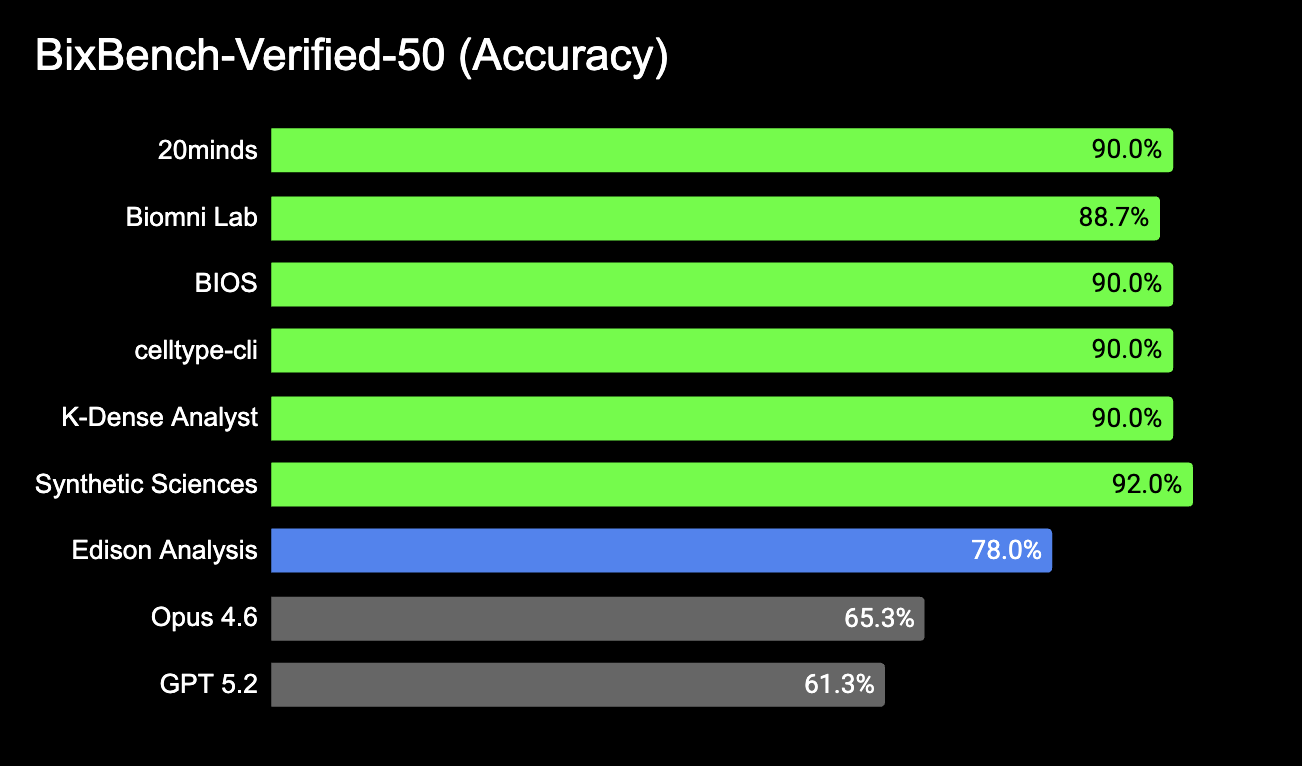
90% accuracy
20minds vs. 65.3% for Claude Code Opus 4.6 on BixBench-Verified-50.
Frequently Asked Questions
What is 20minds Co-Scientist?
20minds Co-Scientist is a web platform for running specialized AI agents for biomedical and data-science research. It provides a shared workspace with consistent authentication, observability, and billing so teams can run different agents without rebuilding their workflow.
How is this different from a general chatbot?
General chatbots are broad assistants. This is designed for structured research workflows with specialized agents, code execution, file-based analysis, and domain-specific reasoning.
Can these agents run code and analyze uploaded files?
Yes. You can upload datasets, run iterative analysis, generate figures, and review intermediate outputs in the same workspace.
Have a question? Please get in touch.